Past Events
Thursday, November 10th, 2011
東アジアにおける高等教育の国際化と英語による国際プログラム(IP-EMIs)の「地域の創造」に対するインパクト
- Presenter: 嶋内佐絵(SHIMAUCHI, Sae)
- PhD Student / GIARI Research Assistant at Graduate School of Asia-Pacific Studies (GSAPS), Waseda University
- Research Fellow at Japan Society for the Promotion of Science (JSPS).
東アジア地域においては、民間の進学志向や高等教育の大衆化、近年における急速な経済成長と国境を越えた人的交流の促進に伴い、各国における高等教育機関でも「国際化」と呼ばれる動きが進展してきた。その中でも、近年増加してい教育プログラムの教授媒介言語を英語にし、英語のみで学位取得を可能にした「International Program(国際プログラム)」である。これらの英語による教育プログラムは、国際社会における国内学生の競争力向上とグローバル人材の育成などの目的のほかに、言語の多様性が豊かな東アジアの高等教育において、英語が教授媒介言語になることによって域内留学の形に柔軟性が生まれ、海外の多様な言語・社会的背景を持った留学生を誘致することを可能にし、東アジア地域内の留学生移動の促進要因ともなっている。さらには、東アジア共同体構想の一環としてアジア版エラスムス計画とも言われる「キャンパス・アジア構想」が現実化し、高等教育分野における国境を越えた域内相互依存関係が進展しつつある。このような潮流を踏まえ、当研究では高等教育の国際化とその中での教育プログラムにおける教授媒介言語の問題に着目し、東アジア地域における将来的な地域共同体形成と、その文脈の中で位置付けられる地域的な高等教育政策の中で、教育媒介言語の問題を議論するためのフレームワークを提示し、今後の地域的共同体形成へ向けた高等教育の地域的発展のための示唆としたい。
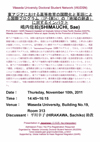 Poster [138KB]
Abstract [89KB]
Date: Thursday, November 10th, 2011
Time: 14:45-16:15
Venue: Waseda University, Building No.19,Room 313
Discussant: 平川幸子 (HIRAKAWA, Sachiko) 助教
Presentation in Japanese (日本語; No Interpreter)
Admission Free / No Pre-Registration Required
Organized by: Waseda University Doctoral Student Network (WUDSN)
Supported by: Global Institute for Asian Regional Integration (GIARI)
Thursday, October 6th, 2011
“Recognizing Regions: The Role of Recognition in Regional Cooperation”
- Presenter: Bernard ONG
- Asia Fellow at the Global Institute for Asian Regional Integration (GIARI);
- PhD Candidate at GSAPS
In the presentation, Mr. Ong focuses on the power of recognition in shaping regional cooperation. He hypothesizes that the extent of recognition accorded to a region has an influence on its development. Then, he examines the hypothesis with newly released U.S. declassified diplomatic records and discusses how recognition was traded between ASEAN and three foreign powers, namely, the U.S., Japan and the European Economic Community, during the grouping’s formative years. He illustrates that the strengthening of a regional concept is influenced by the willingness of, and the extent to which, foreign powers recognize the entity.
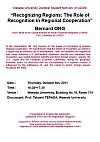 Poster [134KB]
Abstract [124KB]
Date: Thursday, October 6th, 2011
Time: 16:30-17:30
Venue: Waseda University, Building No.19, Room 710
Discussant: Prof. Takashi TERADA, Waseda University
Presentation in English (No Interpreter)
Admission Free / No Pre-Registration Required
Organized by: Waseda University Doctoral Student Network (WUDSN)
Supported by: Global Institute for Asian Regional Integration (GIARI)
Thursday, July 14th, 2011
中国における日本企業の収益性とその決定要因について
- Presenter: 劉曙麗(Liu Shuli)
- PhD Student & GIARI Research Assistant at Graduate School of Asia-Pacific Studies (GSAPS), Waseda University
本報告は、中国の個票データベースから日本企業を選別し、独自のデータベースを構築する事により、計量の手法で、以下の課題を分析したものである:
- 日系企業の収益性は、中国における中華系・外資系と比べ、どのようなレベルになっているか、
- 日系企業の収益性は、どのような要因に決定されているのか。
- さらに、全体として分析できない生産工程別に産業限定で実証分析を行う。
実証分析から得た知見を活かし、日系企業の中国での収益性の向上にも改善法を提示してくれると思われる。特に産業別、生産工程別による細かい分析により得た結果から、日系企業がそれぞれの状況を踏まえて戦略を立てるのにも参考となるだろう。さらに日本企業の海外進出、海外生産経営をサポートする政府関連機関にも政策インプリケーションにも役に立てる研究と思われる。
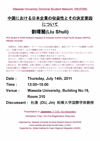 Poster [134KB]
Abstract [124KB]
Date: Thursday, July 14th, 2011
Time: 13:00-15:00
Venue: Waseda University, Building No.19, Room 310
Discussant: 杜進 (DU, Jin) 拓殖大学国際学部教授
Presentation in Japanese (日本語; No Interpreter)
Admission Free / No Pre-Registration Required
Organized by: Waseda University Doctoral Student Network (WUDSN)
Supported by: Global Institute for Asian Regional Integration (GIARI)
Wednesday, June 15th, 2011
中国文化と外交関係
- Presenter: 上村威(UEMURA, Takeshi)
- PhD Student & GIARI Research Assistant at Graduate School of Asia-Pacific Studies (GSAPS), Waseda University.
本論文は中国文化とその外交との関係性を明らかにすることを目的とする。具体的には、中国文化を強く反映した「関係(グァンシー)」という特殊な関係性に焦点を当て、それがどのように中国の対外認識と外交政策の形成に影響を与えるかについて分析する。そのためにまず「関係(グァンシー)」の特徴を整理し、それに基づいて中国外交の行動パターンに関する一連の仮説を立て、日本、旧ソ連、ベトナムおよびアメリカと中国との国際関係の分析を通じてその妥当性を検証していく。なお、今回の報告では特に1972年に日中国交正常化が実現してから2000年ころまでの日本との関係性を扱う。
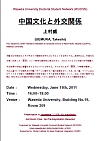 Poster [93KB]
Abstract [154KB]
Date: Wednesday, June 15th, 2011
Time: 16:00-18:00
Venue: Waseda University, Building No.19, Room 309
Presentation in Japanese (日本語; No Interpreter)
Admission Free / No Pre-Registration Required
Organized by: Waseda University Doctoral Student Network (WUDSN)
Supported by: Global Institute for Asian Regional Integration (GIARI)
Tuesday, May 31st, 2011
"QUANTITATIVE ANALYSIS OF THE EFFECTIVENESS OF INTERNATIONAL ENVIRONMENTAL AGREEMENTS"
- Presenter: KIM YOOMI
- PhD Student, Waseda University
The rapid increase in trans-boundary environmental problems has created a need for greater role of global cooperation among nations. Scholars' interest in the effectiveness of international environment agreements (IEAs) has increased in line with the significant increase of IEAs since 1970s. IEAs are the one of the representative international institutional instruments for coping with global environmental degradation. Therefore, analyzing and evaluating the effectiveness of IEAs is needed for the further sustainable development. However, there are not yet sufficient studies using quantitative analysis and discussions about the practical effectiveness of IEAs are still controversial.
Previous studies have primarily been case studies, due to diversity of characteristic of IEAs and difficulties of collecting data and evaluating the effectiveness of IEAs. However, in line with an increasing number of IEAs and building databases of IEAs, quantitative studies have been conducted utilizing various methodologies.
Also, the majority of previous studies have been utilized the data from particular agreements, so they have a limited ability to grasp an overall characteristics of IEAs. Moreover, results from previous studies are also open to dispute. While some scholars insist that their results show positive effects of IEAs on environmental performances, other studies have raised questions about the actual effectiveness of IEAs using empirical evidences. Therefore, there are strong needs to broaden research subjects and models to comprehend the practical effectiveness of IEAs more clearly in order to establish the shape of effective international environmental cooperation.
This study attempts to answer the question: what kind of IEAs are effective on eliminating or reducing particular environmental problems? To answer this question, this presentation is organized as follows.
- The first section offers the review of previous studies which examine the effectiveness of IEAs through quantitative approaches.
- In the second section, each IEA's effectiveness and factors influencing the effectiveness of IEAs are examined by doing empirical analysis. In terms of methodology, panel data which contains not only particular IEAs, but various IEAs are used for regression analysis.
- The last section presents concluding remarks including suggestions for the further sustainable development from the viewpoint of international environmental governance.
 Poster [93KB]
Date: Tuesday, May 31st, 2011
Time: 12:30-14:00
Venue: Waseda University, Building No.19, Room 309
Presentation in English (No Interpreter)
Admission Free / No Pre-Registration Required
Organized by: Waseda University Doctoral Student Network (WUDSN)
Supported by: Global Institute for Asian Regional Integration (GIARI)
Tuesday, February 1st, 2011
"The History Problem, Identity Distance, and Worsening Sino-Japanese Relations"
- Presenter: Yongwook RYU
- Doctoral Candidate, Harvard University
Mr. Ryu argues that in Northeast Asia the salience of the so-called "history problem" widened the identity distance among the regional countries, while in Southeast Asia the process of building a regional identity and the ASEAN Community narrowed the regional identity distance. As a result, regional conflict became more frequent and intense in Northeast Asia, while it decreased in frequency and intensity in Southeast Asia. The analysis of the original multi-country surveys of the political elite reveals that identity distance correlates with key variables that would affect interstate conflict such as threat perception, regional security cooperation, and the willingness to settle disputes. Furthermore, the content analysis of major newspapers in the two regions shows how the identity distance evolved in opposite directions in the two regions.
 Poster [41KB]
Abstract/Biography [26KB]
Date: Tuesday, February 1st, 2011
Time: 12:30-14:00
Venue: Waseda University, Building No.19, Room 310
Commentator: Hiro KATSUMATA, Assistant Professor, WIAP
Presentation in English (No Interpreter)
Admission Free / No Pre-Registration Required
Organized by: Waseda University Doctoral Student Network (WUDSN)
Supported by: Global Institute for Asian Regional Integration (GIARI)
Friday, January 14th, 2011
"Patterns and Determinants of Export Diversification in East Asian Economies: Using Highly Disaggregated Data"
- Presenter: Ferdous Farazi Binti
- PhD Student, GSAPS, Waseda University
Long run economic growth is associated with learning to produce an expanding range of goods. The greater the degree of diversification in export of an economy, the less volatile will export earnings be. Researchers argue that export diversification matters and is especially important for developing countries. On the other hand, product level extensive margin determines the diversification of bilaterally traded good bundles: Why does country 'i' export a very diverse goods bundle to country 'j' while it exports only in a handful of product categories to country 'k'? This study will try to find out how concentrated or diversified are the export patterns in East Asian countries, and what are the determinants for the concentration or diversification. Empirical international trade analyses for accurate and disaggregate trade statistics are increasingly demanding. Contemporary studies suffer from limited commodity coverage while analyzing trade patterns of East Asian countries. This study will contribute to the export diversification literature by presenting and discussing the differences in diversification patterns between East Asian countries by using internationally comparable disaggregated trade data. Traditional trade theories are ill suited to investigate diversification patterns because they provide no explanation of zero trade flows. The "new-new trade theory", by taking into account the fact that not all firms export, has contributed to efforts addressing this shortcoming. This study will examine the pattern of export specialization and the evolution of export diversification in China, Indonesia, Japan, Malaysia, Philippines, Republic of Korea, Singapore and Thailand by using the concentration index at the SITC (rev 3) 3 digit level and HS (rev 2) 6 digit level over the years 2001-2009, covering all commodity data. At the same time, analysis of the presence of many zeros in the trade matrix for the countries of interest will be done by using disaggregated level data.
 Poster [82KB]
Date: Friday, January 14th, 2011
Time: 13:00-14:30
Venue: Waseda University, Building No.19, Room 309
Presentation in English (No Interpreter)
Admission Free / No Pre-Registration Required
Organized by: Waseda University Doctoral Student Network (WUDSN)
Supported by: Global Institute for Asian Regional Integration (GIARI)
Tuesday, November 30th, 2010
“A Political Institutional Approach to International News in the United States: The Case of China's Status as Most Favored Nation”
- Presenter: Troy Knudson
- PhD Candidate, Waseda University
Rather than identifying and interpreting the political effects of news content, this study takes an institutional approach. A quantitative methodology of news coverage regarding China’s status as most favored nation (1994-2000) is employed to ascertain if, and how, the news media acted as an institution in two respects: independently ? through their selective emphasis on contingencies related to China’s status as most favored nation as well as the valence of their representation of the relationship between the United States and China; and politically ? through their relevance to political activity in the United States Congress.
 Poster [66KB]
Date: Tuesday, November 30th, 2010
Time: 12:15-13:30
Venue: Waseda University, Building No.19, Room 309
Presentation in Presentation in English (No Interpreter)
Admission Free / No Pre-Registration Required
Organized by: Waseda University Doctoral Student Network (WUDSN)
Supported by: Global Institute for Asian Regional Integration (GIARI)
Wednesday, November 24th, 2010
Impacts of Globalization on Quality of Life:
Panel Data Evidence from Developing Countries and the Asia-Pacific
- Presenter: Jeet B. Sapkota
- PhD Candidate, Waseda University
- Jeet B. Sapkota is a PhD candidate in GSAPS and Research Fellow in GIARI, Waseda University. Since April 2010, he is serving as a Research Associate in Asian Development Bank Institute in Tokyo. Before came to Japan, he served for the National Planning Commission of the Government of Nepal as a Planning Officer.
In the context of ever increasing globalization trend affecting almost every aspects of people’s life both positive as well as negative ways, this study attempts to analyze the impacts of globalization on quality of life (QOL) in developing countries (DCs) in general and in the Asia-Pacific in particular. The study has three independent analyses using different datasets and both quantitative (panel data econometrics) as well as qualitative (content analytics) methods. First, using the panel data of 126 DCs from 1997 to 2005 it shows that globalization not only promotes human and gender development but also reduces human poverty significantly. Second, from the panel data of 19 Asia-Pacific countries from 1975 to 2005, it demonstrates that overall QOL, measured by the Human Development Index (HDI), of most countries in the region is moving closer to that of Japan (the benchmark country) and that globalization has a significant impact on this convergence process. Finally, it finds that the low-income countries (LICs) in the Asia-Pacific are moderately open (average score of 1.7 on the 0-3 point scale) towards global society. In conclusion, this study makes a number of scholarly contributions to research on the relationship between globalization and QOL by incorporating comprehensive measures and specific elements of both the dependent and explanatory variables with the most recent and a wide coverage of data and some methodological improvements in the analyses.
 Poster [49KB]
Date: Wednesday, November 24th, 2010
Time: 16:30-18:30
Venue: Room 310, Bldg. No.19, Waseda University
Presentation in Presentation in English (No Interpreter)
Admission Free / No Pre-Registration Required
Organized by: Waseda University Doctoral Student Network (WUDSN)
Supported by: Global Institute for Asian Regional Integration (GIARI)
Friday, November 19th, 2010
‘Escaping ASEAN soil: The case of Japan-Korea-China trilateral cooperation’
Japan, Republic of Korea (thereafter Korea), and China have for long been portrayed as rivals ? or at the very least competitors ? in the region of East Asia. Their competition for political initiative has been exercised in regional arrangements, and notably ASEAN Plus Three (APT). Yet it is precisely APT that spurred development of Japan-Korea-China summits, which since 2008 have been convened independently from ASEAN. The tension between competition in APT and emergence of closer cooperation in Northeast Asia prompts us to inquire into the rationale behind development of this trilateral framework. By taking into account China’s rise and Japanese and Korean reaction to it, this research is likely to elucidate a major research puzzle: why Japan, Korea and China ‘escaped’ ASEAN soil to pursue cooperation in a separate format.
- Presenter: Kamila Pieczara
- PHD CANDIDATE, UNIVERSITY OF WARWICK, U.K.
- Kamila Pieczara is a PhD candidate at the University of Warwick, U.K. Her research focuses on explaining emergence of Japan-Korea-China trilateral cooperation. Currently she is hosted by Professor Takashi Terada at the Organisation for Asian Studies (OAS) of Waseda. At the same time she is conducting field research in Tokyo under the Japan Society for the Promotion of Science (JSPS) short-term award. Kamila comes from Poland and speaks basic Japanese and Korean.
- Discussant: Katsumata Hiro
- Assistant Professor, WIAPS
 Poster [59KB]
Date: Friday, November 19th, 2010
Time: 12:10-13:10
Venue: Waseda University, Building No.19, Room 314
Presentation in English (No Interpreter)
Admission Free / No Pre-Registration Required
Organized by: Waseda University Doctoral Student Network (WUDSN)
Supported by: Global Institute for Asian Regional Integration (GIARI)
Thursday, October 14th, 2010
「アジア地域統合」に対する意見形成決定要因の分析と比較―日本人学生を中心に
- Presenter: 劉曙麗(Liu Shuli)
- PhD Student & GIARI Research Assistant at Graduate School of Asia-Pacific Studies (GSAPS), Waseda University.
本稿では、次世代のアジアを形成する日本人の大学生・大学院生を対象としてGIARI(早稲田大学グローバルCOEプログラム・アジア地域統合のための世界的人材育成拠点)で実施された意識調査A-Visionのデータを活用し、次世代の「アジア地域統合」立場形成の決定要因について分析するものである。
本稿では、第一に、民族主義、ナショナリズム、国民アイデンティティー、アジア人アイデンティティーなどの個人意識についての概念を整理する。第二、これらの意識を要因として、どのような地域統合に対する意見が形成されるのかを実証分析する。第三に、これらの意識を要因とする以外に、その他の要因も存在するのか、もしあるならば、それはいかに影響を与えているのかを論じる。
 Poster [129KB]
Abstract [130KB]
Date: Thursday, October 14th, 2010
Time: 13:00-14:30
Venue: Room 501, Bldg. No.19, Waseda University
Presentation in Japanese (日本語; No Interpreter)
Admission Free / No Pre-Registration Required
Organized by: Waseda University Doctoral Student Network (WUDSN)
Supported by: Global Institute for Asian Regional Integration (GIARI)
Friday, July 9th, 2010
Connecting Asia through Education and Economics: Comparative Perspectives
- Presenter 1: Yeeyoung Hong
- Research Assistant, Global Institute for Asian Regional Integration
- Title: "Cross-Border Collaborative Degree Programs in East Asia in the Context of Japanese Universities"
- Ms. Hong's paper analyzes current characteristics of Japanese universities' programs in comparison with case of Asian countries.
- Presenter 2: Insun Kim
- Research Assistant, Global Institute for Asian Regional Integration
- Title: "The Role of Asian Global Companies in Asian Regional Cooperation"
- Ms. Kim's paper reviews how important the role of global companies has been for Asian regional economic cooperation.
 Poster [36KB]
Date: Friday, July 9th, 2010
Time: 12:30-14:00
Venue: Waseda University, Building No.19, Room 501
Presentation in Japanese (No Interpreter)
Admission Free / No Pre-Registration Required
Organized by: Waseda University Doctoral Student Network (WUDSN)
Supported by: Global Institute for Asian Regional Integration (GIARI)
Friday, July 2nd, 2010
"Making East Asian Regionalism Work: Why there is a need for a China-Japan-Korea as well as an ASEAN+3 FTA"
- Presenter 1: Fithra Faisal Hastiadi
- PhD Student, GSAPS, Waseda University
"The Integration of East Asian Economies: towards specialization or diversification?"
- Presenter 2:Farazi Binti Ferdous
- PhD Student, GSAPS, Waseda University
- Research Assistant, Global Institute for Asian Regional Integration
 Poster [29KB]
Date: Friday, July 2nd, 2010
Time: 14.00-16:00
Venue: Room 310, Bldg. No.19, Waseda University
Presentation in English (No Interpreter)
Admission Free / No Pre-Registration Required
Organized by: Waseda University Doctoral Student Network (WUDSN)
Supported by: Global Institute for Asian Regional Integration (GIARI)
Friday, June 25th, 2010
Kinship, Citizenship, and the Problems of International Custody
- Presenter: Allison ALEXY
- Assistant Professor, Dept. of Anthropology and Sociology, Lafayette College, USA
- Discussant: Professor Glenda Roberts, GSAPS, Waseda University
 Poster [22KB]
Abstract [115KB]
Date: Friday, June 25th, 2010
Time: 12:30 - 14:30
Venue: Waseda University, Bldg. No.19, 309
Presentation in English (No Interpreter)
Admission Free / No Pre-Registration Required
Organized by: Waseda University Doctoral Student Network (WUDSN)
Supported by: Global Institute for Asian Regional Integration (GIARI)
Wednesday, June 23rd, 2010
東アジア経済統合に向ける日中経済関係の分析 — (1)貿易の側面から
- Presenter: 劉曙麗(Liu Shuli)
- PhD Student & GIARI Research Assistant at Graduate School of Asia-Pacific Studies (GSAPS), Waseda University.
 Poster [22KB]
Abstract [115KB]
Date: Wednesday, June 23rd, 2010
Time: 18:30 - 19:30
Venue: Waseda University, Building No.19 Room 310
Presentation in Japanese (日本語; No Interpreter)
Admission Free / No Pre-Registration Required
Organized by: Waseda University Doctoral Student Network (WUDSN)
Supported by: Global Institute for Asian Regional Integration (GIARI)
Thursday, June 10th, 2010
MULTIDISCIPLINARY APPROACHES TO THE STUDY OF ASIAN REGIONAL INTEGRATION
- Presenter 1: Takeshi Odaira, PhD Candidate, Waseda University
- Title: "Regional Environmental Cooperation in East Asia: From Track 1 ODA to Track 1.5 Business Arrangement"
- Presenter 2: Pramila Neupane, PhD Candidate, Waseda University
- Title: "Globalization, Education and Development: a comparison between successes and failures in the Asia-Pacific"
- Discussant: Hiro Katsumata, PhD
- Assistant Professor at WIAPS, Waseda University
 Poster [22KB]
Date: Thursday, June 10th, 2010
Time: 12:30 - 14:30
Venue: Waseda University, Building No.19 Room 310
Presentation in English (No Interpreter)
Admission Free / No Pre-Registration Required
Organized by: Waseda University Doctoral Student Network (WUDSN)
Supported by: Global Institute for Asian Regional Integration (GIARI)
Wednesday, June 2nd, 2010
3 Presentations on East Asian Regional Integration
- Presenter 1: Bernard Ong
- PhD Student, Graduate School of Asia-Pacific Studies
- Title: "United States of Asia-Pacific?"
- Presenter 2: Anna Jerzewska
- PhD Student, the University of Leeds
- Title: "The role of Preferences in Japan's FTA Policy Formation — the implications of bilateral and minilateral FTAs with East Asian partners for the prospects of a region-wide trade agreement — "
- Presenter 3: Ying Zhou
- PhD Student, Graduate School of Asia-Pacific Studies
- Title: "China's Soft Power in its Foreign Policy in Asia — Ideas, Institutions, and Responsibilities — "
- Discussant: Shujiro Urata
- Professor at the Graduate School of Asia-Pacific Studies, Waseda University
 Poster [47KB]
Abstract [106KB]
Date: Wednesday, June 2nd, 2010
Time: 16:30 - 18:30
Venue: Waseda University, Building No.19, Room 310
Presentation in English (No Interpreter)
Admission Free / No Pre-Registration Required
Organized by: Waseda University Doctoral Student Network (WUDSN)
Supported by: Global Institute for Asian Regional Integration (GIARI)
Friday, May 28th, 2010
The Social Construction of Sino-Japanese Relations and Northeast Asian Politics
- Presenter 1: Karl Gustafsson
- PhD Candidate, Stockholm University
- Title: RETHINKING THE 'HISTORY PROBLEM' IN SINO-JAPANESE RELATIONS
- Presenter 2: Christian Wirth
- PhD Candidate, Waseda University
- Title: OCEAN GOVERNANCE, MARITIME SECURITY, AND THE CONSEQUENCES OF MODERNITY IN NORTHEAST ASIA
- Discussant: Hiro Katsumata, PhD
- Assistant Professor at WIAPS, Waseda University
 Poster [78KB]
Date: Friday, May 28th, 2010
Time: 12:30-14:30
Venue: Waseda University, Building No.19, Room 711
Presentation in English (No Interpreter)
Admission Free / No Pre-Registration Required
Organized by: Waseda University Doctoral Student Network (WUDSN)
Supported by: Global Institute for Asian Regional Integration (GIARI)
Monday, May 17th, 2010
"A Bad Rap: Democracies as Terrorist Targets"
- Presenter :Joseph T. Walsh
- PhD student of International Relations at University of Alabama. USA.
- Nearly every study conducted the past twenty years finds that terrorists are more likely to attack democracies, yet this literature fails to account for the wide variation of attacks found within regime types. Walsh argues that contested territory is a cause of regime type and terrorism, and therefore the democracy-terrorism link may be spurious. Using the Global Terrorism Database to identify transnational terrorist attacks from 1970 to 2001, he finds little evidence that democracies are more prone to terrorist attacks than other regimes but strong evidence that states with territorial disputes are.
- Abstract [10KB]
 Poster [80KB]
Date: Monday, May 17th, 2010
Time: 12:15-14:15
Venue: Waseda University, Building No.19, Room 310
Presentation in English (No Interpreter)
Admission Free / No Pre-Registration Required
Organized by: Waseda University Doctoral Student Network (WUDSN)
Supported by: Global Institute for Asian Regional Integration (GIARI)
Friday, May 14th, 2010
"Appearance of the concept of regional aid toward three Indochina countries "
- Presenter :SHIMABAYASHI, Takaki
- PhD Student at Graduate School of Asia-Pacific Studies (GSAPS), Waseda University.
- Mr. Shimabayashi's research discusses the Japanese ODA policy toward three Indochina countries from the time when Japan returned to international community to the time when the Cambodian conflict was over. In particular, his presentation analyzes when the concept of ODA focusing on a "region" emerged as well as the factors caused the emergence.
- Abstract [139KB]
 Poster [96KB]
Date: Friday, May 14th, 2010
Time: 10:30-12:30
Venue: Waseda University, Building No.19, Room 310
Presentation in Japanese (No Interpreter)
Admission Free / No Pre-Registration Required
Organized by: Waseda University Doctoral Student Network (WUDSN)
Supported by: Global Institute for Asian Regional Integration (GIARI)
Tuesday, April 13th, 2010
Globalization, Human Development and Quality of Life in the Asia-Pacific
- Presenter :Jeet Sapkota, PhD Candidate, Waseda University
- Jeet Sapkota is a 3rd Year PhD candidate at the Graduate School of Asia-Pacific Studies (GSAPS) and Research Fellow of the Global Institute for Asian Regional Integration (GIARI) at Waseda University. Since July 2009, he is serving as an Executive Member of the Association of Pacific Rim Universities Doctoral Student Network (APRU-DSN). Before coming to Japan, he served for the National Planning Commission of the Government of Nepal for 3 years as a Planning Officer. His research interest revolves around globalization and quality of life (QOL) in the Asia-Pacific.
- Abstract [47KB]
Japan's Growing Interest in China: The Case of Manufacturing Sector FDI, 1990-2008
- Presenter :Mohd. Faisal, PhD Candidate, Jawaharlal Nehru University
- Mohd. Faisal is a Doctoral Candidate at the Jawaharlal Nehru University, Dew Delhi, India and currently a Japan Foundation Fellow affiliated with Waseda University.
- Abstract [73KB]
 Poster [60KB]
Date: Tuesday, April 13th, 2010
Time: 12:30-14:30
Venue: Waseda University, Building No.19, (Room to be announced on posters at the 1st, 5th and 8th floors)
Presentation in English (No Interpreter)
Admission Free / No Pre-Registration Required
Organized by: Waseda University Doctoral Student Network (WUDSN)
Supported by: Global Institute for Asian Regional Integration (GIARI)
Tuesday, March 23rd, 2010
"Chiang Mai Initiative Multilaterals; the significance for East Asian Regionalism"
- Presenter :Joel Rathus, Adelaide University
- Joel Rathus is a PhD Candidate at Adelaide University, Australia and a Monbukagakusho Scholar based at Meiji University, Tokyo.
- Abstract [13KB]
The presentation is focused on three problems; what is it about the CMI that allows it successfully multilateralize while other, arguably more important, elements of regional integration are ignored? Why is it that many scholars and involved parties doubted that the CMI would progress? And what are the likely implications of multilateralization of the CMI for East Asian regionalism at large.
 Poster [80KB]
Date: Tuesday, March 23rd, 2010
Time: 12:30-14:30
Venue: Waseda University, Building 19, Room 314
Discussant: Hiro Katsumata, PhD, Assistant Professor at the Waseda University Institute of Asia-Pacific Studies (WIAPS)
Presentation in English (No Interpreter)
Admission Free / No Pre-Registration Required
Organized by: Waseda University Doctoral Student Network (WUDSN)
Supported by: Global Institute for Asian Regional Integration (GIARI)
Tuesday, March 16th, 2010
Dividends of Sustainability: Impacts of Development Policies in Asia
- Presenter :Dharish DAVID, PhD Candidate, Waseda University
- Title: "THE POLITICAL ECONOMY OF NATIONAL HIGHWAYS FINANCING IN INDIA:
THE SCOPE FOR FINANCIAL INTERMEDIATION IN INFRASTRUCTURE INVESTMENT" - Abstract / Short Biography [6KB]
- Presenter :Jeet SAPKOTA, PhD Candidate, Waseda University
- Title: "IMPACTS OF GLOBALIZATION ON HUMAN QUALITY OF LIFE (QOL) IN ASIA"
- Abstract / Short Biography [7KB]
 Poster [22KB]
Date: Tuesday, March 16th, 2010
Time: 15:00-17:00
Venue: Waseda University, Building No.19, Room 314
Presentation in English (No Interpreter)
Admission Free / No Pre-Registration Required
Organized by: Waseda University Doctoral Student Network (WUDSN)
Supported by: Global Institute for Asian Regional Integration (GIARI)
Tuesday, March 9th, 2010
The Political Structure in the ARF: what matters for security regime development in the Asia-Pacific region?
- Presenter :Satoshi MARUYAMA
- Ph.D. candidate at Graduate School of Asia Pacific Studies (GSAPS), Waseda University and Research Fellow at Global Institute for Asian Regional Integration (GIARI), Waseda University.
- Title: "The Political Structure in the ARF: what matters for security regime development in the Asia-Pacific region?"
The research objective is to explore and identify improving factors and hindering factors in the development of the ASEAN Regional Forum (ARF) which is a comprehensive and cooperative security dialogue framework in the Asia-Pacific region. The region currently faces not only traditional security issues such as proliferation of nuclear weapon and territorial disputes, but also increasing non-traditional security issues such as terrorism, transnational crimes and natural disasters. The ARF has dealt with the above political and security issues for sixteen years, and has gradually developed its function, albeit at a slow pace. The 27 participant states include key regional actors such as the United States and China. Therefore, examining political interaction and consensus on various agendas in the ARF, particularly between key regional powers, is essential in understanding what factors are conducive to the development of regional security cooperation.
 Poster [63KB]
Date: Tuesday, March 9th, 2010
Time: 14:00-16:00
Venue: Waseda University, Building 19, Room 314
Discussant: Professor Chikako Kawakatsu UEKI, PhD, GSAPS, Waseda University
Presentation in English (No Interpreter)
Admission Free / No Pre-Registration Required
Organized by: Waseda University Doctoral Student Network (WUDSN)
Supported by: Global Institute for Asian Regional Integration (GIARI)
Tuesday, February 23rd, 2010
The Formation of Bio-Politics and Fascism in Japan
- Presenter : KAWAJI, Kinuyo
- PhD Candidate Graduate School of Political Science, Research Assistant Global Institute for Asian Regional Integration (GIARI), Waseda University.
- Title: "The Formation of Bio-Politics and Fascism in Japan"
- Abstract [67KB]
Ms. Kawaji's research investigates the phenomenon of "Japanese fascism" in terms of continuity and universality of bio-politics from the pre-war and war-time movement of "socialization" to the post-war "welfare state" in Japan. The research explores the ideological transformations with relations to social structure in the inter-war period, by reflecting upon our questions of life. Her research focuses particularly on the analysis of the ideological transformation from the inter-war to the war-time by exploring activities of a Japanese social activist Kagawa Toyohiko. In her presentation, she compares Kagawa's humanistic activities with contemporary social works such as caseworkers, the charities of NGOs and social policies of the state.
 Poster [68KB]
Date: Tuesday, February 23rd, 2010
Time: 17:00-19:00
Venue: Waseda University, Building No.19, Room 314
Presentation in Japanese (日本語; No Interpreter)
Admission Free / No Pre-Registration Required
Organized by Waseda University Doctoral Student Network (WUDSN)
www.waseda-giari.jp/jpn/wudsn/index_e.html
Supported by Global Institute for Asian Regional Integration (GIARI)
Thursday, February 4th, 2010
Transnational Network and Participation in Regional Cooperation - Asia
- Presenter : Alice Park LEE
- PhD Candidate at Graduate School of Asia-Pacific Studies and Research Assistant at Global Institute for Asian Regional Integration (GIARI), Waseda University.
- Title: "Transnational Network and Participation in Regional Cooperation - Asia"
- Abstract / Short Biography [13KB]
Ms. Alice Park Lee's research is centered on states' participation in regional environmental institutions. She seeks to answer how economic and political dimensions motivate Asian countries in transnational networks of regional environmental institutions. In this presentation, the economic dimension will be examined by cost benefit analysis of domestic views. Her analysis on economic indicators and Social Discount Rate of 15 existing regional intergovernmental institutions will show the general structure of the institutions, using cases including the North-West Pacific Action Plan (NOWPAP) and the North Pacific Maine Science Organization (PICES). The results of the analysis show that security issues and political leadership, in addition to the diplomatic merit of participating in Asian transnational networks is high. By working on increasing economical, cultural, historical and institutional motivations, Asian countries can be further motivated and become committed to regional environmental cooperation.
 Poster [81KB]
Date: Thursday, February 4th, 2010
Time: 12:15-14:00
Venue: Waseda University, Building No.19, Room 314
Presentation in English (No Interpreter)
Admission Free / No Pre-Registration Required
Organized by Waseda University Doctoral Student Network (WUDSN)
www.waseda-giari.jp/jpn/wudsn/index_e.html
Supported by Global Institute for Asian Regional Integration (GIARI)
Tuesday, January 12th, 2010
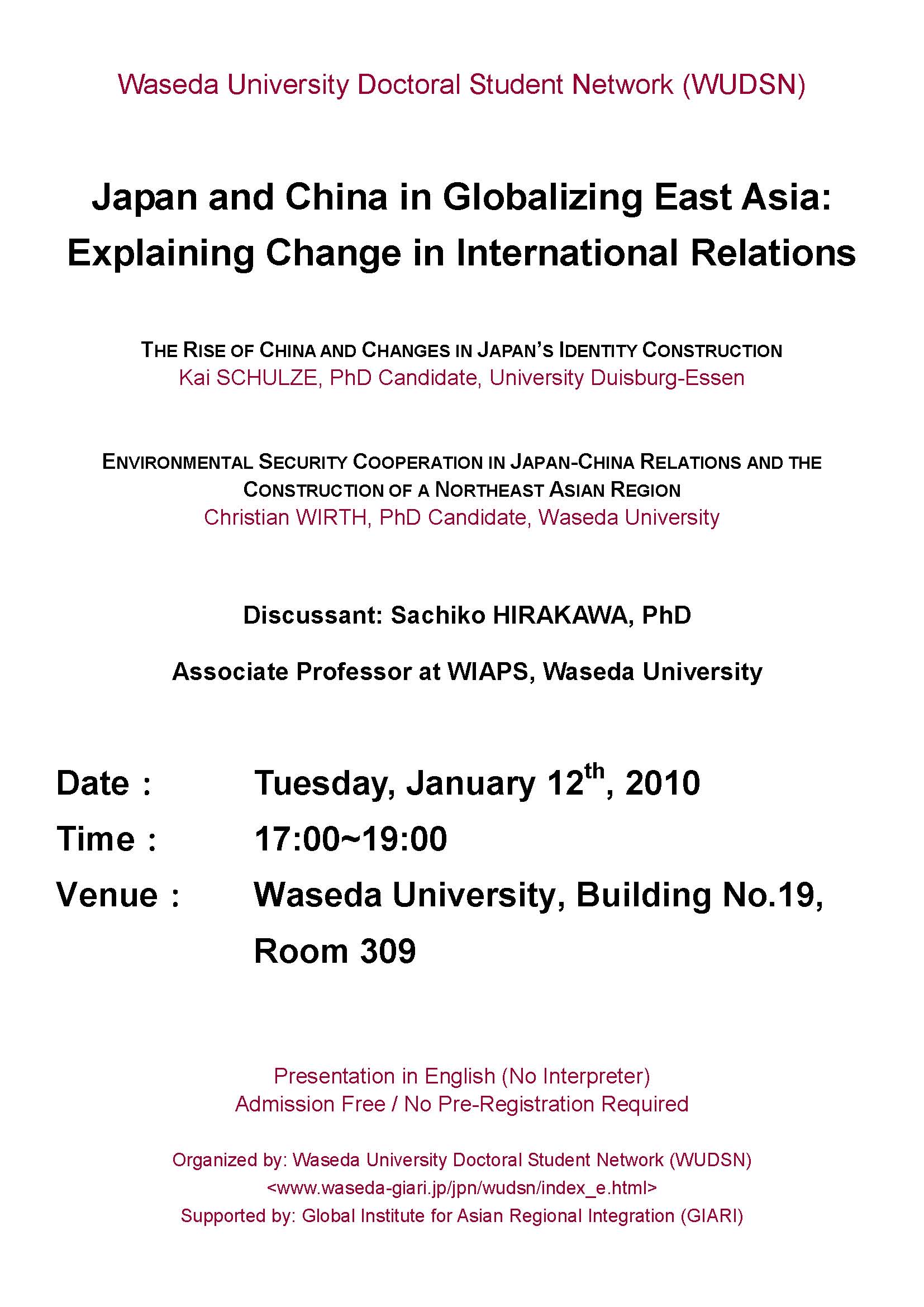
Japan and China in Globalizing East Asia: Explaining Change in International Relations
- Presenter 1: Kai SCHULZE
- PhD Candidate, University Duisburg-Essen
- Title: "THE RISE OF CHINA AND CHANGES IN JAPAN'S IDENTITY CONSTRUCTION"
- Presenter 2: Christian WIRTH
- PhD Candidate, Waseda University
- Title: "ENVIRONMENTAL SECURITY COOPERATION IN JAPAN-CHINA RELATIONS AND THE CONSTRUCTION OF A NORTHEAST ASIAN REGION"
- Discussant: Sachiko HIRAKAWA, PhD
- Associate Professor at WIAPS, Waseda University
Abstract / Short Biography [23KB]
 Poster [80KB]
Date: Tuesday, January 12th, 2010
Time: 17:00-19:00
Venue: Waseda University, Building No.19, Room 309
Presentation in English (No Interpreter)
Admission Free / No Pre-Registration Required
Organized by Waseda University Doctoral Student Network (WUDSN)
www.waseda-giari.jp/jpn/wudsn/index_e.html
Supported by Global Institute for Asian Regional Integration (GIARI)
Saturday, December 19th, 2009
"Panel: Regional Identity in Asian Integration Research"
Panel Objective
The concept of identity has recently gained considerable currency in the social sciences. Within Asia, the concept of an Asian regional identity has been stressed as a component essential to the process of Asian integration and the formation of an Asian community. This has partly been because the commonalities among countries that would be emphasized through identity construction are also seen as means by which integration can be deepened and by which a regional community can be built. It has even been suggested that the lack of an Asian identity is the central problem for the region to solve, a goal that is evidenced by the clear embedding of the future role of identity in some regional institutions. This vision of identity as a functional tool of Asian integration requires researchers to both fully characterize this identity as well as make an account of how it is constructed and represented. In doing so, it is important to recognize the dynamic existent in Asia when regional and national perspectives clash. This dynamic exists outside the region as well, as countries outside Asia grapple with the idea of engaging an integrated Asian region. Thus, it is also important for researchers to recognize that identity is a question of standpoint; to capture the complexity of the Asian region's identity requires consideration of a multiple number of standpoints, including those from outside the region. This forum addresses the necessity to discern how the concept of an Asian regional identity is being and can be defined internally and externally. Three presenters will address these issues theoretically and empirically from standpoints within, as well as outside, Asia.
- Presenter 1: Aminuddin Baki
- PhD Student, Graduate School of Asia-Pacific Studies
- Research Assistant, Global Institute for Asian Regional Integration
- Title: "Conceptualization of Collective Identity in South East Asian Integration"
- Presenter 2: Akiko Ishioka
- PhD Student, Graduate School of Asia-Pacific Studies
- Title: "The Significance of Cultural Heritage for an East Asian Community: The Case of University Students at Beijing, Renmin, Fudan, and Shanghai Jiaotong Universities in China"
- Presenter 3: Troy Knudson
- PhD Student, Graduate School of Asia-Pacific Studies
- Research Fellow, Japan Society for the Promotion of Science
- Title: "Asian Integration's Low Visibility in the United States Elite Press: External Reflections and Asian Regional Identity Construction"
 Poster [86KB]
Date: Saturday, December 19th, 2009
Time: 13:00-15:00
Venue: Waseda University, Building No.19, Room 309
Discussant: Shigeto Sonoda, Professor of Sociology at the Institute of Oriental Culture, University of Tokyo
Presentation in English (No Interpreter)
Admission Free / No Pre-Registration Required
Organized by Waseda University Doctoral Student Network (WUDSN)
Supported by Global Institute for Asian Regional Integration (GIARI)
Tuesday, November 24th, 2009
"The Internationalization of Higher Education from Institutional and Individual Perspectives: The Case of Vietnam National University, Hanoi"
- Speaker: Nguyen Thuy Anh
- PhD Candidate at Graduate School of Asia-Pacific Studies and Research Assistant at Global Institute for Asian Regional Integration (GIARI), Waseda University.
- She is currently a faculty member of the College of Economics, Vietnam National University.
- Abstract [35KB]
Ms. Nguyen Thu Anh's research is centered on the internationalization of tertiary education and Asian regional cooperation and integration in the field of higher education. The main purpose of this study is to investigate how internationalization of higher education is perceived and implemented at the institutional and individual levels in a specific context from the perspectives of the institutional key actors. To this end, the research firstly studies the practices and strategies of internationalization at VNU and its member institutions. Secondly, it examines the rationales, risks, obstacles and priorities attributed to internationalization in VNU by its key actors. Finally, it investigates how key actors' perceptions and practices are different from or similar to one another depending on their backgrounds.
Date: Tuesday, November 24th, 2009
Time: 17:00-19:00
Venue: Waseda University, Building No.19, Room 309
Presentation in English (No Interpreter)
Admission Free / No Pre-Registration Required
Organized by Waseda University Doctoral Student Network (WUDSN)
Supported by Global Institute for Asian Regional Integration (GIARI)
Wednesday, November 11th, 2009
"The Possibilities and Limitations of Japanese Multicultural Coexistence: An Analysis of Contemporary Approaches to Diversity Through the Prism of Multiculturalism"
- Speaker: Stephen R. Nagy, PhD
- Assistant Professor at the Chinese University of Hong Kong's Japanese Studies Department
- Research Associate at Waseda University's Institute of Asia-Pacific Studies from October 2007 to November 2009.
- Abstract/Short Biography [88KB]
Stephen's research is centered on the implications of migration in non-traditional countries of immigration such as Japan, Korea and Taiwan, the manner integration will take place and future constructs of national identity, nationality, citizenship and the ability of these countries to navigate through this process. He is also interested in research linking human security and migration to Asian regional integration.
 Poster [79KB]
Date: Wednesday, November 11th, 2009
Time: 18:00-20:00
Venue: Waseda University, Building No.19, Room 309
Discussant: Gracia Liu-Farrer, PhD, Associate Professor at GSAPS, Waseda University
Presentation in English (No Interpreter)
Admission Free / No Pre-Registration Required
Organized by Waseda University Doctoral Student Network (WUDSN)
Supported by Global Institute for Asian Regional Integration (GIARI)
20 October 2009
A History of Mediation: How Academics Have Dealt with Methods of Non-Institutionalized Conflict Resolution
- Speaker: ODAIRA Takeshi
- Doctoral Student at GSAPS
- Research Assistant at GIARI, Waseda Univ.
How have the scholars of different disciplines and regions studied mediation in conflicts? In order to answer this research problem, the presenter will qualitatively explain the course of development of the studies of mediation in different disciplines and countries such as in Japan and the United States.
The presentation aims to explain the evolution of the concept of mediation in the academic literature of different disciplines. While many researchers admit the need to develop various methods of conflict resolution to end violent conflicts at all levels of analyses, few articles systematically explain the evolution of non-institutionalized methods of conflict resolution. Now that it is difficult to establish institutionalized mechanisms of third-party conflict resolution to end violence between parties in the Asia-Pacific region, it is reasonable to focus more on non-institutionalized mechanisms of third-party conflict resolution such as good offices, mediation and conciliation. Among these non-institutionalized methods to manage various conflicts, mediation is used more often than others in the world, including the Asia-Pacific region.
While mainly scholars of the law discipline have produced a great amount of works on mediation as an alternative dispute resolution to complement the malfunction of formally institutionalized legal institutions, it is going to be revealed that there is a need for further research on how the different types of mediators can coordinate with each other to cooperatively end armed conflicts.
Date: 20 October 2009, 17:00-18:30
Venue: Room 710, Building No. 19 Nishi-Waseda Campus, Waseda University
Presentation in English (No Interpreter)
Admission Free / No Pre-Registration Required
Organized by Waseda University Doctoral Student Network (WUDSN)
Supported by Global Institute for Asian Regional Integration (GIARI)
7/1 (Wed) Prof. David Chapman’s Lecture (45 minutes)
Title: Bare Life and Invented Subjects: Early History of the 'Naturalized Foreigners' of the Bonin (Ogasawara) Islands.
- Guest Speaker: Professor. David Chapman
- Senior Lecturer in Japanese University of South Australia
- Professor. David Chapman is senior lecturer in Japanese at the University of South Australia where he coordinates the Japanese studies program. He is the author of Zainichi Korean Identity and Ethnicity (Routledge 2008). His research interests focus on the history of minority communities in Japan.
- His two latest projects continue in this direction. One project is examining the history of identification and documentation through Japan's population registration system (koseki). The other project is an attempt at recording the life histories of the 'Westerners' of the Ogasawara/Bonin Islands.
- Introduction - explaining the early history of the Bonin/Ogasawar Islands and the process of naturalization
- Main Body -
- Contextualise the Islands in the time of the Bakumatsu and early Meiji period.
- Introduce the role of the koseki and legislation conected to this community
- Introduce theoretical concepts of Georgio Agamben's Bare Life'
- Connect with the Island's early history
- Conclusion
- Extensive Q&A Session
Date: July, 1st (Wed) 16:30-18:30
Venue: Sodai-Nishiwaseda Bldg 19 Room 711
(早大西早稲田ビル19号館 711号室)
Language: English
Organized by WUDSN
Supported by GIARI
6/23 (Tues)
Title: United States News Coverage and Congressional Attention toward China in the post-Cold War: a Time Series Analysis
- Speaker: Mr. Troy. Knudson
- PHD Candidate at Waseda University’s Graduate School of Asia Pacific Studies
- JSPS; Japanese Society for the Promotion of Science
This study explores the relationship between the elite press and foreign policy decision-makers in the United States in the context of post-Cold War. Two inquiries are put forth: the first seeks to determine if United States post-Cold War news coverage of China has been congruent with the national interest; the second seeks to statistically determine if patterns of attention paid to China in the United States Congress followed changes in the news media's coverage. Results show that while news coverage of China was only partly congruent with the national interest, it was a very good predictor of Congressional attention over the same time period.
Date: June, 23rd (Tues) 16:30~18:30
Venue: Sodai-Nishiwaseda Bldg 19 Room 316
Organizer: WUDSN / Supported by GIARI
Language: English
6/17(Wed)
Title: 現代中国における社会変化と都市社区建設に関する一考察
― 北京市における多様化する居住環境を事例として ―
- Speaker: Mr. Yoji Osada (長田洋司)
- アジア太平洋研究センター助手
- 早稲田大学大学院アジア太平洋研究科博士後期過程
改革開放以降、中国都市において様々な社会変化が起こっている。そして、その変化への対応として中国政府は2000年から「社区建設」という基層管理体制の改革をスタートさせた。本報告では、政府が上から設定したコミュニティの形に対して、その実態を考察することに焦点を当てる。特に、中国の新しいコミュニティの可能性を持つ「回龍観文化居住区」の事例を取り上げながら、そこで機能する社会的ネットワーク形成ツールとその背後にいるキーパーソンの存在について分析する。
日時: 2009年 6月 17日(水)16 : 30~18:30
Date: June, 17th (Wed) 16:30~ 18:30
会場: 早大西早稲田 ビル19号館 316号室
Venue: Sodai-Nishiwaseda Bldg 19 Room 316
Organizer: WUDSN / Supported by GIARI
Language: Japanese
6/9 (Tues)
Title: Retirement Migration in Japan : Critical Study of Previous Studies for Research Design
- Speaker: Ms. Sookyung Park
- 2nd year of PhD Candidate, Graduate School of Asia Pacific Studies, Waseda University
This study highlights the needs for further research on retirement migration in Japan, focusing on critical review of previous studies. It is said that Japanese elderly are unwilling to move out or migrate after their retirement, but recently the interest on retirement migration is growing and also the number of retirement migrants is increasing, especially international retirement migration from Japan. However, the researches on retirement migration in Japan are scarce compared to US and UK which have been conducting studies on elderly migration at both domestic and international level from the 1960's. Further, the scarce researches on retirement migration in Japan usually focus on rural or domestic migration and the impacts at post-migration, i.e. psychological wellbeing.
Therefore, the main goal of this study is to create research design for further studies by studying previous reviews on retirement migration in US and UK, considering whether it is possible to apply US and UK's studies to Japan and what are the different characteristics between Japan and US-UK.
Next step for further research is to conduct fieldwork and employ case study methodology to reveal the reasons of migration and migrants' social network to their family. The retired life is more important because of increasing of life expectancy and therefore this further study is more important considering retirement migrant's independence and care problems at both private and social levels.
Date: Tuesday, June, 9th , 16:30 - 18:30
Venue: Sodai-Nishiwaseda Bldg 19 Room 316
Organizer: WUDSN / Supported by GIARI
Language: English
May 26th by Mr. Eiji Yamamoto 山本英嗣 (日本語発表)
Waitangi条約とニュージーランドの現在-マオリの人権を中心として-
- Speaker: Mr. Eiji Yamamoto 山本英嗣
- 早稲田大学アジア太平洋研究センター特別研究員
- アジア太平洋研究科博士課程2年
本報告では、まずニュージーランドにおける人権概念を整理し、かつては英国の植民地化のために利用されたワイタンギ条約について、その歴史的経緯を整理する。特に「条約」(ここでは法的強制力を伴うハードローの一つ)が、今日、英連邦諸国の一員として、先住民であるマオリ族の人権にどのように影響を及ぼし、「パケハ」(ヨーロッパ系を中心とするエスニック集団)との「共生」のためどのように変化し、その役割を担っているのか、ニュージーランド権利章典(1990年)や国際人権法等の影響も踏まえて考察したい。
また、コモンロー体系を採用するニュージーランドで、枢密院司法委員会でのワイタンギ条約の法的判断も併せて報告する予定である。
日時: 2009年 5月26 日(火)18 :00 - 20:00
Date: Tuesday,May 26th, 18:00 - 20:00
会場: 早大西早稲田 ビル19号館 608号室
Venue: Sodai-Nishiwaseda Bldg 19 Room 608
Organizer: WUDSN / Supported by GIARI
Language: Japanese
May 12th by Mr. Jeet Bahadur Sapkota
Impacts of Globalization on Human Welfare and Poverty in Developing Countries in the Asia-Pacific in Comparison with Other Regions: Evidence from Panel Data
- Speaker: Mr. Jeet Bahadur Sapkota
- PhD Candidate, Graduate School of Asia Pacific Studies
- Research Fellow, Global Institute for Asian Regional Integration
This paper examines the impacts of globalization on human welfare and poverty in developing countries in the Asia-Pacific region in comparison with other regions of the world. The paper uses the panel data of all the developing countries as far as data are available on the World Development Indicator (WDI) online database of the World Bank and the Human Development Reports (WDR) of the United Nations Development Programs (UNDP). Applying the regression analysis method the paper shows that all the major elements of globalization, including international trade, foreign direct investment (FDI), foreign aid, international migration and international tourism, have positive and significant impacts on human development in the Asia-Pacific region as well as elsewhere in the world. It also finds out that these factors have negative but significant impacts on human poverty as well. Comparatively, in South Asia, global economic integration has a more significant impact on human development than in countries in the Asia Pacific Region but a less significant impact than in the Sub-Saharan Africa region. This indicates that the poorer the region is, the greater the impact of global economic integration. This finding is also supported by the other results. For instance, in the Low Income Countries (LICs) the impact of global economic integration is the highest as compared with the Lower-Middle Income Countries (LMCs) and even lower than for the Upper Middle Income Countries (UMCs). Thus, it is concluded that the globalization benefits the poorer countries more, which ultimately helps to meet the United Nations' Millennium Development Goals (MDGs) by reducing human poverty significantly. However, further research is essential to examine the impacts of globalization on certain geographical areas, certain group of people, and on certain sectors within a country.
日時: 2009年 5月 12日(火) 16:00-18:00
Date: Tuesday, May, 12th, 16:00-18:00
会場: 早大西早稲田 ビル19号館 316号室
Venue: Sodai-Nishiwaseda Bldg 19 Room 316
Organizer: WUDSN / Supported by GIARI
Language: English
April 27th by Ms.Lui Sullen (劉 曙麗)
日本企業の対中進出立地要因の経済分析
-産業により求めている生産ネットワークと集積効果も異なるのか?
- Speaker: Ms.Lui Sullen (劉 曙麗)
- 早稲田大学アジア太平洋研究科・国際関係学専攻・博士課程
- 早稲田大学グローバルCOEプログラム・アジア地域統合フェロー
アジア諸国の経済関係を見るために、直接投資と貿易の研究が不可欠である。特にアジア地域においては、直接投資を行う担い手として日本企業が大きな役割を果たしているのに対し、受け手としては、発展途上国(中国、タイなど諸国)が比較的大きな位置を占めている。また、中国、タイなど現地にある日系企業によるアジア地域内貿易と対米などの地域外貿易が活発に行っている。
このように、日本企業の対アジア進出に関する経済分析は、アジア地域内外の経済関係を理解するには重要なテーマである。2007年末までの進出別の日本企業現地法人数データからみれば、アジア諸国にある日本企業の現地法人数(12,710件)は全体(21,264件)の50%以上に占めている。且つ日本企業に一貫重視された北米地域(3,547件)を遥か超えた。
日本企業のアジアへの進出立地は、国別にみると、中国(4,878件)は最大の受入れ国であり、その次は、タイ(1,577件)、シンガポール(991件)、台湾(896件)、マレーシア(759件)である。その一方、同じくアジアにあるその他の国(例えば、プルネイ、ネパール)に進出した日本企業が数件しかない。もっと興味深いのは、中国の国内においても、同じ傾向が見られる。日本企業は、上海(1,709件)、江蘇省(740件)、広東省(721件)に集中立地している一方、その他の中国地域に直接投資はそれほどないである。
本論文では、東洋経済の『海外進出企業総覧』の個票データを用いたロジット・モデル分析を行い、日本企業の中国での立地要因を産業別により深い検討を加えることとする。
投資受入(国)地域の直接投資を引き付ける要因は、市場規模、インフラ整備、労働コストなど伝統的な要因以外、国際生産ネットワークを活用できる集積効果という要因が挙げられる。本論文は産業により求めている生産ネットワークと集積効果が異なるのかについて、日本企業の中国での立地をケースとして、実証分析を行った。
日本企業の対中進出する立地要因を明らかにすることは、それ自体大きな意味を持つのみならず、今後の日本企業の立地動向及びアジア地域内外の貿易の予測や分析にも繋がるものである。アジア経済関係に関する理解にも参考できると思われる。
日時: 2009年4月27日(月)14:30-16:30
Date: Monday, April, 27th 14:30-16:30
会場: 早大西早稲田 ビル19号館 316号室
Venue: Sodai-Nishiwaseda Bldg 19 Room 316
Organizer: WUDSN / Supported by GIARI
Language: Japanese 日本語発表
April 21st by Mr. Nobuyuki Kishida
The chemical warfare in the Asia-Pacific war and its aftermath: From the Australian Experiments to the ACW disposal in China
- Speaker: Mr. Nobuyuki Kishida
- 2nd year of PhD candidate in the Graduate School of Commerce at Waseda University
- Mr. Kishida translated Bridget Goodwin's book "Keen as Mustard" into Japanese. He will present this book and hold a discussion about the implications of the work for Japanese.
- MBA, Waseda Business School, Graduate School of Asia-Pacific Studies, Waseda University, 2005
- B.A., Political Science, School of Political Science and Economics, Waseda University, 1988.
Although the Imperial Japanese usage of the chemical warfare (CW) during the Asia-Pacific War was known to the Allied, it had been kept as a secret from post war Japanese people for several decades. Worst of all, it makes difficult to deal with CW side effects for Japan nowadays, such as the disposal of the abandoned chemical warfare (ACW) in China, the lawsuits by the ACW victims, and so on.
On the other hand, there was another well kept secret CW issue on the Allied side. Large scale experiments were conducted in Australia from 1942 to 1945 so as to prepare possible invasions with CW. Not knowing the evil after effect of the mustard gas, over 2,000 Australians were used as "human guinea pigs" in harsh field experiments. Many of them had suffered seriously for life without adequate compensations.
In the presentation, discussions on the implications of new knowledge from the Australian experiments will be made after brief surveys on the Japanese CW and its aftermaths. It includes the recent progress of ongoing issues mentioned above.
日時 2009年4月21日(火)16:00~18:00
会場 早大西早稲田 ビル19号館 316号室
Organizer: WUDSN / Supported by GIARI
Language: English
Commentator: Dr. Bridget
Goodwin Author of “Keen as Mustard”
Former Associate Professor at Bond University
Journalist and Film Maker
Feb 24 by Mr. Guilherme Kenji Chihaya
Class, Status and Lifestyle in PRC
Speaker: Mr. Guilherme Kenji Chihaya
2nd year of MA student in International Relations Graduate School of Asia-pacific Studies at Waseda University
Bachelor in Media Studies from Rio de Janeiro State University
Title: Class, Status and Lifestyle in PRC
This presentation aims at showing how social stratification in the People's Republic of China can be explained through a Weberian framework of Class and Status stratification.
Economic inequality has been the focus of much research on Chinese social stratification. Schemes based on income, employment status and nature of workplace have been used to analyze Chinese society in terms of Class stratification, even though the term used may not be 'Class'.
However, there is a a less explored side of Chinese social inequality. That is a hierarchy of Status which exists in terms of symbolic inequality as a order in which social esteem is distributed. This Status order exists in parallel to the economic stratification, although they are related in many aspects, and is reflected in social relationships such as friendship and marriage.
Using data from nation-wide surveys, this research derives an occupational status measure from patterns of association between Chinese working adults. The same data is then used to demonstrate how aspects of lifestyle such as consumption and political participation relate differently to Class and Status stratification in China.
Date: Tuesday, February 24th, 18:00 - 20:00
Venue :Sodai-Nishiwaseda Bldg 19 Room
Language: English
Feb 10 by Akiko Onodeara
How Japan behaved towards emerging regionalism
Speaker: Ms. Akiko Onodera (Ph.D candidate in Politics and International Studies from University of Warwick, UK. )
Title: How Japan behaved towards emerging regionalism
- Thesis outline
- 1. Introduction,
Introduction of regionalism theory - 2. General Analysis on Japanese diplomacy and policy making
- 3. The historical perspective of Japanese Foreign Policy towards ASEAN from Fukuda doctrine to Asian Crisis
- 4. How Japan behaved against regionalization after Asian crisis?
Develop the regionalism theory of the East Asia region
Touch upon East Asian community and Japanese Foreign policy. - 5. Case study.
How Japan behaved against emerging FTA in the region, by analysis on negotiation process of Japan-Thailand Economic Partnership Agreement
Date: Tuesday, February 10th, 10:30~12:00
Venue: Sodai-Nishiwaseda Bldg 19 Room 314
Organizer: WUDSN / Supported by GIARI
Language: English
Commentator: Prof.Urata
Professor of Economics( Graduate School of Asia-Pacific Studies at Waseda University)
Research fellow, Japan Center for Economic
Research.Faculty fellow, Research Institute of Economy, Trade and Industry
Jan 27 by Troy Knudson
Problem Defining the US Consumer Product Safety Improvement Act: Perception of Chinese Manufacturing as a Cause
Speaker: Mr. Troy Knudson
(Ph.D candidate at Waseda University)
Research fellow at the Japan Society for the Promotion of Science
Master's degree in peace and conflict studies from Tokyo University of Foreign Studies
Title: Problem Defining the US Consumer Product Safety Improvement Act: Perception of Chinese Manufacturing as a Cause
This paper aims to show why and how the Consumer Product Safety Improvement Act appeared on the US political agenda in 2007. Employing the concept of policymaking as a process of problem definition, an analysis of dominant frames within the news media and political discourse is taken to identify the respective perceived causes of the problems addressed in the act. Results show that in the news media as well as in Congressional debates, Chinese manufacturing is emphasized as a major factor leading to certain actions taken by the act, such as increasing the capacity of the Consumer Product Safety Commission.
Date: Tuesday, January 27th, 18:00-20:00
Venue: Sodai-Nishiwaseda Bldg 19 Room 314
Organizer: WUDSN / Supported by GIARI
Language: English
Jan 20 by Chris Wirth
Traditional Versus Non-Traditional Security in Japan-China Relations and East Asian Regional Cooperation.
The research paper aims to contribute to the understanding of regional identity formation with regard to bilateral and multilateral security cooperation in Northeast Asia. It focuses on the two major Asian regional actors, China and Japan. Mostly centering on questions of traditional national security, Sino-Japanese relations have often been characterized as the result of a ‘power shift’, contentions about history or as a result of conflicting identities.
However, since the 1990s, processes of globalization are dramatically changing the socio-economic and political environment in East Asia. It is thus necessary to analyze bilateral and regional security cooperation comprehensively.
This paper therefore seeks to explain the linkages between questions of traditional and non-traditional security in Sino-Japanese relations. The study evaluates Sino-Japanese policy coordination through bilateral and multilateral channels in the areas of maritime security and energy security against the background of their overall security-political relationship since 1990.
Speaker: Mr. Chris Wirth
(Ph.D candidate at Waseda University)
Research Fellow at the Global Institute for Asian Regional Integration (GIARI)
Master of International Affairs from the Australian National University in 2005.
Master of Law from the University of St. Gallen in 2001.
Date: Tuesday, January 20th, 18:00 - 20:00
Venue: Sodai-Nishiwaseda Bldg 19 Room 314
Organizer: WUDSN / Supported by GIARI
Language: English
Jan 13 by Stephen R. Nagy
Speaker: Mr.Stephen R. Nagy
Research Associate, Institute of Asian Pacific Studies,Waseda University
Inter-regional Asian Emigration and the Potential for International Cooperation in East Asia: A Comparative Examination of State Integration Policies in Korea and Japan.
This paper aims to comparatively examine the integration practices of Japan and Korea at the state level to help understand the measures being taken to mitigate some of the migratory pressures resulting from deepening Asian regional integration and to enhance human security in the region. Specifically, the author aims to examine the state-led initiatives vis-à-vis Japan and Korea's burgeoning multicultural societies in an effort to comparatively examine their approaches to securing the human rights and security of their growing migrant populations. Through identifying parallels and differences in the approaches of the Japanese and Korean governments in terms of securing human rights and security, the author will outline potential areas of cooperation in dealing with growing trans-border migration between these two countries and in Asia in general.
Date: Tuesday, January 13nd, 18:00~20:00
Venue: Sodai-Nishiwaseda Bldg 19 Room 314
Organizer: WUDSN / Supported by GIARI
December 16th(Tue)
by Ms. Nilly Kamal El-Amir &
Mr.Hidekazu Iwamoto
"Regional Integration and Environmental Security in the Japanese Politics"
Speakers:Ms. Nilly Kamal El-Amir (PhD Candidate, Faculty of Economics & Political Science,Cairo University, Egypt / Visiting Researcher, The Graduate School of Economics , Waseda University)
As a result of the increasing awareness of protecting environment on the local, regional and international levels, since 1970s the security studies have been expanded to include new dimensions and concepts such as: human security, energy security and environmental security…
Currently there is little coherence around the world about environmental security's definition, threats, and policy responsibilities. However, it can be defined as: "The relationship between security concerns such as armed conflicts and the natural environment".
In this respect, the research aims at introducing and analyzing definitions of the concept of environmental security and its related concepts, as: environmental citizenship, environmentalism…
Since ODA is considered as one of the main tools of implementing the Japanese policy, this research will try to explore how central is that tool in enhancing the environment's quality on East Asia on one hand and the environmental regional cooperation on the other hand.
Examining the statements of both Game and Coalition theories, the paper will raise the following questions:
- What are the main definitions of the environmental security concept?
- How can the environmental aid and
世界遺産管理における社会的環境管理能力の形成と制度変化に関する一考察:日本の自然遺産・屋久島を事例に
Speakers: 岩本 英和 Mr.Hidekazu Iwamoto (PhD Candidate at GSAPS, Waseda University)
本研究の目的は、世界遺産地域(自然遺産)の屋久島を対象に、保護と利用の観点から持続可能な自然資源管理体制を明らかにすることである。1972年に採択された世界遺産条約は、条約加盟国に対して、自国内の遺産を保全する法的措置を義務付けているが、必ずしも保全が厳格に実施されていないという問題がある。そこで、環境ガバナンスの各主体と社会的環境管理能力(SCEM)の視点から自然遺産管理システムの社会的能力評価を行い(Matsuoka 2007)、保全と利用を念頭に置いた持続可能な管理システムの構成要素・制度形成のあり方を考察する。
Commentator:
Prof. Matsuoka at GSAPS (Environmental security,Environmental politics Specialist)
Date Tuesday, December 16th, 18:00 - 20:00
Venue Sodai-Nishiwaseda Bldg 19 Room 314
Organizer WUDSN / Supported by GIARI
Tuesday, December 2nd
by Mr. Ye Kyaw Thu
Speaker:Mr. Ye Kyaw Thu
(Ph.D candidate at Waseda university)
B.Sc. degree in Physics from Dangon University,Myanmar in 2000.
M.Sc degree in Global Information and Telecommunication Studies, Waseda University , Japan in 2006.
Member of MCPA, IEICE, IPSJ, IEEE and ACM.
Introduction to Concepts of Positional Mapping(PM), Positional Gesture(PG) and Positional Prediction (PP) for Asian Syllabic Languages on Mobile Devices
I believe that text typing on small mobile devices will become more popular and necessary communication in Asian developing countries such as Myanmar, Bangladesh, Nepal, Bhutan, Laos and Cambodia etc. In these countries, however, there in no efficient and user-friendly text input method for mobile devices yet. Asian languages are syllabic languages that derived from Indic script or Brahmi around BC third century. And thus, Myanmar language or Burmese, Bengali, Nepali, Dzongkha (language of Bhutan), Lao and Khmer have common writing natures with Indian languages such as Hindi, Marathi, Punjabi and Tamil etc. But current mobile devices key-mapping or text input methods such as multi-tap or T9 are based on English and not directly applicable to syllabic languages are different and have larger numbers of characters than English alphabets. My research looks for common and user-friendly keyboard mapping and text input methods for Asian syllabic languages based on their word formation or writing natures for mobile devices. I have already proposed 1)Positional Mapping (PM) for mobile phone or Personal Digital Assistant (PDA) keyboard mapping 2)Positional Gesture (PG) for gesture text input interface and 3)Positional Prediction (PP) for consonant cluster predictive text input.
Date Tuesday, December 2nd, 18:00~20:00
Venue Sodai-Nishiwaseda Bldg 19 Room 314
Organizer WUDSN / Supported by GIARI
Tuesday, November 25 2008
Speaker: Ms. Nilly Kamal El-Amir
PHD student, Waseda University
Title: "Regional Integration and Environmental Security in the Japanese Politics"
Tuesday, November 18th 2008
Ministries Policy Competition over Internationalization of Japan's Higher Education
This lecture will compare the differences of policy directions towards the internationalization of higher education between ministries, agencies, and advisory bodies. As a result, it is pointed out that there are various conflicting interests between the participants in them, such as politicians, bureaucrats, academics, business leaders, trade union, and so on. This paper argues that these conflicts result in advantage and disadvantage to implement the internationalization of higher education in Japan. The advantage is that various ministries and agencies can participate in policy-making process, so that the diverse views of Japanese society can be reflected to the policies. On the other hand, it is disadvantageous in that overall coordination functions are lacking in the policy-making process.
Title:Ministries Policy Competition over Internationalization of Japan's Higher Education
Speaker:Dr. Masato Kamikubo
Research Fellow at Waseda University Global COE program: Global Institute for Asian Regional Integration
Visiting Fellow at Organization of Asian Studies, Waseda University
Lecturer at Faculty of Law, Rikkyo University
Commentator:Kazuo Kuroda , Graduate School of Asia-Pacific Studies, Professor
Date and Venue
Date:Tuesday, November 18th, 18:00-20:00
Venue:Sodai-Nishiwaseda Bldg 19 Room 314
Organizer:WUDSN / Supported by GIARI
Poster[386KB]
Tuesday October 27
Title: Elderly Criminals - A Model for Analysis of Types of Crimes
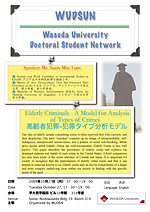 The idea of elderly people committing crime is often received first with curiosity and then skepticism. The term "criminal" conjures up an image of irresponsibility, self-indulgence, interpersonal intrusiveness, and a pattern of social rule-breaking. While news stories about Elderly Abuse are well-documented, Elderly Crime is less well known. This paper describes the prevalence of elderly crime and explains the dominant patterns and trends of such crime in the United States. A brief comparison has also been made of the crime statistics of Canada and Japan. It is important for society to recognize that the phenomenon of elderly crime exists and that it can happen to someone known to us. Elderly crime may in fact be symptomatic of a larger and more complex underlying issue within our society in dealing with the specific needs of the aged.
Speaker: Ms.Soon-May Lum
Second year Ph.D. Candidate in International Studies at GSAPS.
Master of Arts (Gerontology) from San Francisco State University in the U.S.A
Bachelor of Business Administration (B.B.A.) from the National University of Singapore.
Date and Venue
Date Tuesday October 27, 17:00 - 19:00
Venue Sodai-Nishiwaseda Bldg 19 Room 314
Organized by WUDSN
Language English
October 17th (Friday), 2008
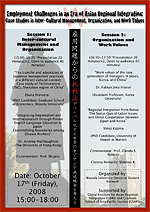
Employment Challenges in an era of Asian Regional Integration: Case Studies in Inter-cultural Management, Organization, and Work Values
 Greetings from Waseda University!
The Waseda University Doctoral Student Network (WUDSN), with the generous support of Waseda University's Global Institute for Asian Regional Integration (GIARI) will hold a symposium on Friday, October 17th 2008, from 15:00 to 18:30. The symposium is entitled:
" Employment Challenges in an era of Asian Regional Integration: Case Studies in Inter-cultural Management, Organization, and Work Values "
At this meeting we our fortunate enough to have speakers with expertise on issues related to Employment Challenges in an era of Asian Regional Integration. Please see the symposium schedule below for more information about the speakers, titles of presentations, and attending discussants.
I would like to take this opportunity to invite all of you to this symposium. The event will be held at the Graduate School of Asia Pacific Studies, Building 19, Rm 710 from 15:00 to 18:00. Please see attachments for details on presentation and the aims of the Waseda University Doctoral Student Network.
For information on how to get to Waseda University and about up coming events please refer to our homepage:http://www.waseda-giari.jp/jpn/wudsn/contact.html
Although registration is not necessary, organizers would greatly appreciate an email confirming your interest in attending. Please send email to Stephen Robert Nagy (s.nagy@aoni.waseda.jp) with name, affiliation, research area and email contact.
We hope that you will be able to join us for a stimulating afternoon of presentations and ample opportunity to exchange opinions, ideas and comments with our panelists.
Sincerely,
Stephen R. Nagy(Chair of Waseda Doctorial Student Network)
Date and Venue
Theme:
Employment Challenges in an era of Asian Regional Integration:
Case Studies in Inter-cultural Management, Organization, and Work Values
Date:
October 17th (Friday), 2008
15:00-18:00
Venue:
the Graduate School of Asia Pacific Studies, Building 19, Rm 710 from 15:00 to 18:00.
Organized by:
Waseda University Doctorial Student Network
Supported by:
Global Institute for Asian Regional Integration (GIARI)
and Graduate School of Asia Pacific Studies (GSAPS)
Welcome Address:
Prof. Satoshi Amako (Chair of Global COE Program "Global Institute for Asian Regional Integration")
Program
Welcome Address:
Prof. Satoshi Amako (Chair of Global COE Program "Global Institute for Asian Regional Integration")
Opening Remarks:
Mr. Yasuyuki Kishi
Session 1: Inter-cultural Management and Organization
(15:00-16:20 *Presentation 20 minutes×2, Open to audience 40 minutes)
Commentator: Prof. Shigeto Sonoda
"The transfer and adaptation of Japanese management practices in a different cultural context: Case study of Technocentre (TNC), Shenzhen region of China"
Zhaka Pranvera (PhD Candidate, Graduate School of Commerce, Waseda University)
"Integrating Regionalism and Internationalism through Private English Language Education in Japan: Essentializing Boundaries among Eikaiwa Workers"
Dr. Andrew MacNaughton (The University of Hong Kong)
Session 2: Organization and Work Values
(16:30-17:50 *Presentation 20 minutes×2, Open to audience 40 minutes)
Commentator: Prof. Glenda S. Roberts
"Work values of the new generation of managers in Japan, Korea, and China"
Dr. Fabian Jinte Forese (Assistant Professor, Korea University)
"Regional Integration from Below: The Status Quo of Labor Issues and Union Cooperation between Japan and Korea"
Shinji Kojima (PhD Candidate, University of Hawaii at Manao)
Closing Remarks:
Stephen R. Nagy (Chair of Waseda Doctorial Student Network)
September 16, 2008
Irrational Consumer Behavior: Emotional and Unconscious Buying Mechanisms
Speaker
- Mr. Min Kyung Hyun
PhD Candidate, Graduate School of Asia Pacific Studies/ Research Associate, Institute of Asia Pacific Studies, PhD Candidate, Waseda Business School.
Abstract
In recent times, there is an increasing amount of research from a variety of view points into irrational consumer purchasing behavior. For example, one school of thought focuses on unconscious purchases habits. Another school of thought focused on the emotional and conscious irrational purchasing habits of consumers. Recently many researchers are focusing on such arguments, but up until now the theories have been for the most part abstract and/ or instinctive.
In order to clarify the factors that contribute to temptations that lead to irrational consumer purchasing habits, it is necessary to identify consumers’ needs. In order to make an effective marketing strategic plan, it is necessary to study such buying habits in a rational manner.
This present research attempts to examine the existent recognition theory and also economical rationale. The research will also examine decisive factors through analyzing information from media and advertisements from shops to show the impact of irrational informational interpretation. The goal will be to show factors that finally impact consumer internal buying behavior.
Commentator
TBA
Date and Venue
Date : Tuesday September 16 17:00~19:00
Venue : Sodai-Nishiwaseda Bldg 19 Room 314
Organized by : WUDSN
Supported by : GIARI
Open to public, Free of charge
September 9, 2008 Featured Speaker
Japanese, Korean, and Taiwanese Company Business Location Decision Making
An Economic Analysis and Comparison
Speaker
- Ms. Lui Sullen (GIARI Research Fellow)
School of Asian-Pacific Studies, Waseda UniversityMs. Lui Sullen is a PHD candidate at Waseda University's Graduate School of Asia Pacific Studies and a research fellow at the Global Institute of Asian Regional Integration.
Abstract
Upon joining the WTO in 2001, China, in addition to experiencing a high level of growth, also saw an increase in foreign investment. However when disagglomerated to the provincial level, there is a large difference in growth. Indeed, just the areas surrounding Shanghai, Jiangsu, Zhejiang, represent 35% of foreign direct investment (FDI). If Guangdong and Shandong provinces are considered as well, it represents 61% of total FDI. In this way, China’s post-WTO investment environment has seen a radical increase, but the fact remains that foreign companies investing in China demonstrate a high level of agglomeration as before.
In particular the case of Japanese, Korean, and Taiwanese companies (representing the 2nd, 5th, and 6th largest FDI contributors, respectively) demonstrate a strong agglomerative tendency. Japanese companies agglomerate around the Beijing/Tianjin Delta, Shanghai/Chiang Jang Delta and the Guangzhou/Zhu Jiang Delta Korean companies agglomerate around Liaoning/Shandong. Finally, Taiwanese companies are shifting from Guangdong to Jiangsu. Given this, what are the main factors that affect location decision making in companies from each country? In this thesis, by evaluating location decision factors for companies entering China on a provincial basis, this paper will attempt to analyze the location factors, and the efficiencies surrounding an international production network. In addition, by looking at other Asian cultures within China by area, this analysis will look at whether there are differences between the areas and if so, what kind of impact does this have on these areas.
In analyzing the above, this paper will show that there is a strong tendency towards agglomeration by Japanese, Korean and Taiwanese firms. In the Midwest of China it seems to be difficult to increase FDI as has been done in the Eastern regions. Indeed, it might even be the case that this FDI-influenced Eastern agglomeration could accelerate regional differences within China. Lastly, through an economic analysis, this research hopes to contribute to the growing discussion around Asian region international in respects to policies for attracting foreign firms and policies for improving inter-regional differences.
Commentator
TBA
Date and Venue
Date : Tuesday September 9 17:00~19:00
Venue : Sodai-Nishiwaseda Bldg 19 Room 314
Organized by : WUDSN
Supported by : GIARI
Open to public, Free of charge
July 1, 2008 Featured Speaker
Social Movement Change Urban Governance
A study to the social movement for urban conservation in China (1990’s-)
Speaker
Yao Yuan (Ph.D. Student in Political Science )
School of International Studies, Peking University
School of Asian-Pacific Studies, Waseda University
Yao Yuan is a Ph.D. Student of the Double Degree Program of Peking-Waseda University, major in Comparative Politics. He is now conducting the doctoral research on Chinese social movement about urban conservation issue. Around this topic, he has already published dozens of articles both in academic journals and newspapers, including Harvard China Review, South Weekend, or China Youth Daily. He is also the editor-in-chief of the UNESCO book Beijing and Beijing: A Critical Dialogue (2005).
Abstract
During rapid urbanization since early 1990’s, Chinese local governments launched a nationwide Urban Renovation Campaign to historic cities and towns in order to serve the real estate development. Unfortunately, this campaign not only leaded to irreversible cultural, environmental, and scenic loss, but also created serious social, economical, and legal disputes.
However, Chinese public is more actively participating in urban affairs in order to protect the Old City. Inhabitants, volunteers and NGOs discuss and act for protecting the culture heritage, while numerous Websites, BBS and blogs offer them such a platform. Increasingly independent media actively spread their appeals to the public. The rising social movement for urban conservation becomes possible to influence policy process, which was nearly closed to the public for a long time.
Why the social movement for urban preservation can succeed in influence policy process, even change the models of urban governance? How the movement really moves? I will explain it through four factors of the movement: its origins, its mobilization, its strategy, and its outcome.Through this research we may:
- understand the reason d’etre of contemporary political system,and evaluate how it works;
- reveal what is changing in China politics;
- Point out what might be the orientation of political reform.
Commentator
TBA
Abstract(English)[pdf]
Date and Venue
Date : Tuesday July 1st 17:00-19:00
Venue : Sodai-Nishiwaseda Bldg 19 Room 314
Organized by : WUDSN
Supported by : GIARI
Open to public, Free of charge
Friday, June 20th, 2008
Symposium: Migration in East Asia: Perspectives from Japan, China and Taiwan
Organised by the Waseda University Doctoral Student Network
Supported by: GIARI
Date: Friday, June 20th 2008
Place: Graduate School of Asia Pacific Studies, Waseda University
Time: 15:00-19:00
Room: TBA
Cost: Free
To attend: Send email to Stephen Robert Nagy (s.nagy@aoni.waseda.jp) with name, affiliation, research area and email contact.
Panel 1:
- Dr. David Chapman, University of South Australia/Waseda University
Title: Sealing Japanese Identity - Dr. Soo Im Lee, Ryukoku University
Title: The underlying Myths, Beliefs and Calculations reflected in the Naturalization Policy in Japan - Stephen Robert Nagy, Research Asssociate, Institute of Asia Pacific Studies, Waseda University
Title: Examining the Role of Local Governments in Social Integration: A Comparative Examination of Social Integration Practices at the Local Government Level in Japan - Dr. David Blake Willis, Soai University
Title: Dejima: Legacies of Exclusion and Control - Discussant: Professor Glenda S. Roberts
Graduate School of Asia-Pacific Studies, Waseda University
Panel 2:
- Dr.Gracia Liu Farrer(University of Chicago, PhD) Sophia University
Title: "Creating a Transnational Community: Chinese Newcomers in Japan,"
explaining the trends of Chinese migration into Japan, and why and how they are transnational in their adaptation patterns and the construction of their identity as "new overseas Chinese." - Peipei Han, PhD Candidate at the Graduate School of Asia Pacific Studies, Waseda University
Title: Diaspora, Hidden "In-between-ness", Cross-borderer: an Exploration of Taiwanese Immigrants' Identity in Contemporary Japan - Discussant: Professor Shigeto Sonoda
Graduate School of Asia-Pacific Studies, Waseda University
Abstract(English)[pdf]
Brochure(English)[pdf]
Tuesday, June 10th 2008 18:00-20:00 Bldg. 19
Title:
A change of the urban fundamental structure and the possibility of transformation for the government-society relation in China: As a case of Beijing
発表者:長田洋同、早稲田大学アジア太平洋研究センター助手、アジア太平洋研究科博士課程
タイトル:現代中国における都市基層構造の変化と政府-社会関係の変容可能性:北京市を事例として
Tuesday, May 27th 2008 18:00-20:00
Title: Rethinking Yasukuni Problem in Sino-Japanese Relations Implication towards Regional Integration
- Speaker 1:
Cheung Mong, Research Associate, Institute of Asia-Pacific Studies PhD
Candidate, Graduate School of Asia-Pacific Studies, Waseda University, Japan - Commentator:
Sven Saaler Associate Professor, The University of Tokyo, Graduate School of Arts and Sciences - Abstract(English)[pdf]
May 13th 2008
News about China in the US Media since the Cold War's End:Analysis of Three Structural Determinants
- Speaker:Troy Knudson, PhD Candidate, Waseda University
- Commentator:TBA
- Abstract(English)[pdf]
Tuesday, April 22nd 2008 18:00-20:00
題名:日本の地域社会における対外国人意識の新しい形態―北海道稚内市と富山県射水市を事例として―
- 発表者:小林真生、早稲田大学アジア太平洋研究科博士課程
- Commentator:鈴木 江理子 (すずき えりこ)
立教大学兼任講師、一橋大大学院社会学研究科博士後期課程に在籍中(研究テーマは「日本で働く男性長期非正規滞在者」)。日本の外国人政策や国際労働力移動、地域社会の多文化化などについて研究するかたわら、外国人支援の現場でも活動している。主要著書は『多文化化する日本を考える-国境を越えた人の移動が進展するなかで』(FIF Special Report No.8, 2004)、『「多文化パワー」社会-多文化共生を超えて』(共編著,明石書店,2007)など。 - Abstract(Japanese)[pdf]
- Abstract(English)[pdf]
Tuesday, April 8th, 2008 18:00-20:00 RM 314 BLDF. 19
Title: China’s Commitment in the Creation of an East Asian Free Trade Area (EAFTA): An ASEAN+3 FTA or/and an ASEAN+6 FTA?
Speaker: Ganjar Nugroho, PhD Candidate, Graduate School of Asia Pacific Studies, Waseda University
Tuesday, March 18th, 2008 17:00-19:00 RM 710 BLDG. 19
Title: The politics of flexible labour markets in Germany and Japan:How globalisation and economic restructuring has transformed coordination and consensual policy-making practices.
- Speaker: Steffen Heinrich, M.A. PhD candidate / Research Associate (from April 1), University of Heidelberg Institute of Political Science
- Abstract[pdf]
Wed, February 20th & Thrus. February 21st 2008
International Joint Symposium on “Socio-political Transformation in Globalizing Asia: Integration or Conflict?”
Co-Hosted by
BK21 “Promoting Applied Sociology in Conflict Society”?
Global COE Program “Global Institute for Asian Regional Integration” and
21st Century COE Program “Center for the Study of Social Stratification and Inequality”
Tuesday, February 12, 2008 17:00-19:00 RM 710 BLDG. 19
Title: Educationally Channeled International Labor Mobility: Contemporary Student Migration from China to Japan
- Speaker: Dr. Gracia Liu Farrer, COE Post Doctoral Research Fellow at the Center for the Study of Social Stratification and Inequality, Tohoku University
- Abstract[pdf]
Tuesday, January 22, 2008 17:00-19:00 RM 710 BLDG. 19
Theme: Japan’s Domestic Human Rights Record and its Implications for Asian Integration
- Speaker 1: Debito Arudo, Associate Professor, Hokkaido Information University
Title:Japan’s Internationalization and Asian Regional Cooperation - Speaker 2: Ms. Sonoko Kamikawa, Amnesty International Japan
Title: Implications of Japanese domestic human rights record (for foreign residents or Japanese) on Asian Integration from the perspective of an NGO and in particular Amnesty International Japan - Commentator: Dr. Yasushi Katsuma, Associate Professor Graduate School of Asia-Pacific Studies, Specialty: Human Rights
- Abstract[pdf]
Tuesday, January 15, 2008 17:00-19:00 RM 710 BLDG. 19
Theme: Diversity in the Asian Workplace
- Speaker 1: Mr. Yasuyuki Kishi, Research Associate, Institute of Asia-Pacific Studies, PhD Candidate at the Graduate School of Asia? Pacific Studies
Title: Organizational Attractiveness of Japanese Companies in Taiwan - Speaker 2: Ms. Fengye Sun, Research Assistant and PhD Candidate at the Global Center of Excellence (GIARI),Graduate School of Economics, Waseda University
Title: Gender-Wage difference in Japanese affiliated subsidiaries in China: A statistical analysis using intra-firm personal data - Abstract[pdf]
Tuesday, December 11, 2007 17:00-19:00
Theme: Media Perceptions in Asia
- Speaker 1: Mr. Troy Knudson
Research Assistant and PhD Candidate at the Global Center of Excellence (GIARI), Graduate School of Asia Pacific Studies, Waseda University
Title: US News Media Representation of Economic Integration between China and Japan - Speaker 2: Ms. Pauline Cherrier, University of Lyon, Lumiere
Title: Brazilian-Japanese: Identity Redefining Processes and Media Representations - Abstract[pdf]
November 7th, 2007 17:00-19:00 (in cooperation with ICC)
Theme: Perspectives on International Migration to Japan
Title: Cross-border Migration and Identity Transformation: Case Study of Taiwanese Diaspora in Contemporary Japan
Speaker 1: Peipei Han, PhD Candidate, Waseda University
Title: Chinese Student Migration, Socio-professional Mobility and Civic Participation
Speaker 2: Dr. Helene La Bail, PhD, Institute of Political Science of Paris
October 22nd, 2007 14:40-17:00
Topic: Human Rights and Japan’s New Fingerprint Laws for Non-Japanese
Speaker: Debito Arudo, Associate Professor, Hokkaido Information University
October 17th, 2007 17:30-19:30 (in cooperation with ICC)
Theme: Tokkotai and their Memorialization
Speaker 1: M.G. Sheftall, Associate Professor of Communication Studies, Shizuoka University , PhD Candidate, Waseda University Graduate School of Asia Pacific Studies
Title: Rhetorical Activities of Postwar Japanese Kamikaze Memorialization
Speaker 2: Dr. Sven Saaler, Associate Professor, Graduate School of Arts and Sciences, University of Tokyo
Title: Tokkotai Memorialization in the Broader Context of Japanese Society
August, 22nd 2007 14:00-16:00 (in cooperation with ICC)
Topic: The Nuclear Test at the Marshall Islands, Then and Now
Speaker: Seiichiro Takemine, PhD Candidate, Graduate School of Asia Pacific Studies
Commentator: Professor Hatsue Shinohara, Waseda University
July 4th, 2007 17:30-19:30 (in cooperation with ICC)
Title: Individualization and Changing Attitudes toward Work: Freeter and Beyond
Speaker 1: Carola Hommerich, PhD Candidate, Research Institute for Sociology, University of Cologne
Title: The Loss of Traditional Work Ethics? An Intergenerational Comparison
Speaker 2: Fabian Froese, PhD Candidate, Graduate School of Asia Pacific Studies, Waseda University
June 22nd, 2007 14:40-16:40
Title: Human Rights and Japan’s New Fingerprint Laws for Non-Japanese
Speaker: Debito Arudo, Associate Professor, Hokkaido Information University
June 6th, 2007 18:00-20:00
Title: Local Government Multicultural Coexistence Practices in the Tokyo Metropolitan Area:Integrating a Growing Foreign Population
Speaker 1: Stephen Robert Nagy, PhD Candidate, Graduate School of Asia Pacific Studies, Waseda University
May 9th, 2007 18:00-20:00
Title: Post Disaster Communication Challenges Disaster Recovery Platform: Japan as a Case Study
Speaker 1: Jose Luis Ochoa, PhD Candidate, Graduate School of International Management, Waseda University
